
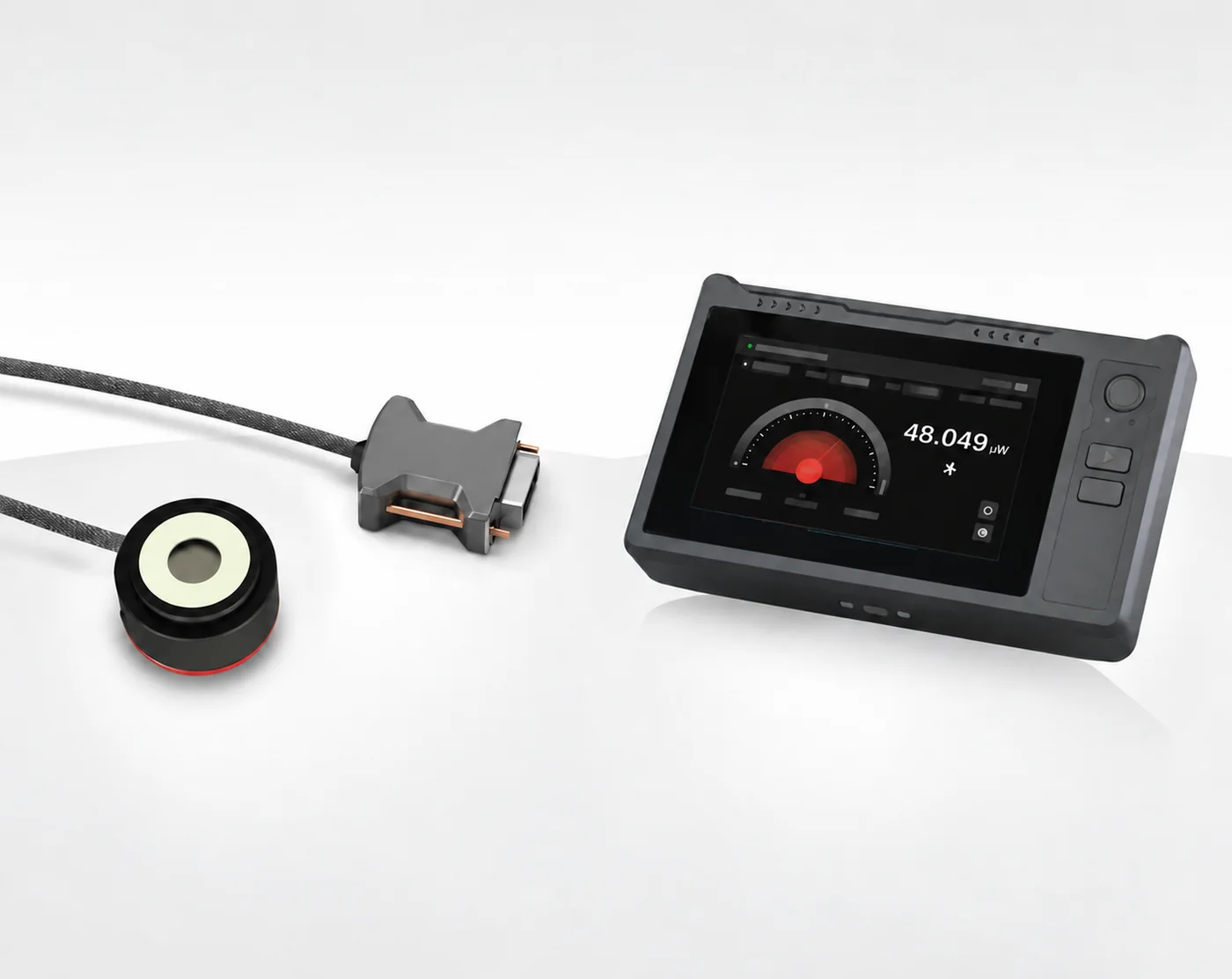
Laser power meters are often described as the multimeters of optics. They convert incident optical power into an electrical signal, then apply amplification, calibration, filtering and digital processing to report power in watts, milliwatts, microwatts or dBm.
The detector technology determines the useful wavelength range, power range, response speed, sensitivity and tolerance to beam conditions.
Photodiode Power Meters
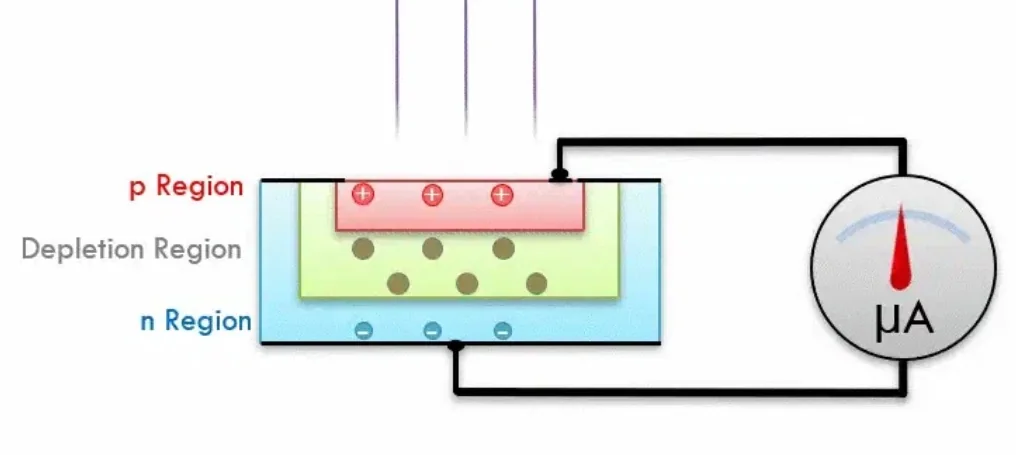
A photodiode converts photons into charge carriers inside a semiconductor junction. Under reverse bias, the resulting photocurrent is proportional to incident optical power. Silicon, germanium and InGaAs detectors cover different wavelength bands.
Strengths
- Very fast response, commonly in the microsecond range and sometimes faster.
- High sensitivity and resolution for low-power signals, including nanowatt-level measurements.
- Compact detector heads for laboratories, production lines and field service.
Limitations
- Strong light can saturate or permanently damage the detector.
- The usable spectral range is limited by the semiconductor material.
- Accuracy can be affected by wavelength setting, temperature, ambient light and connector cleanliness.
Best suited to: fiber-optic communications, optical-component testing, alignment work, low-power lasers and applications that need fast response.
Integrating-Sphere Power Meters
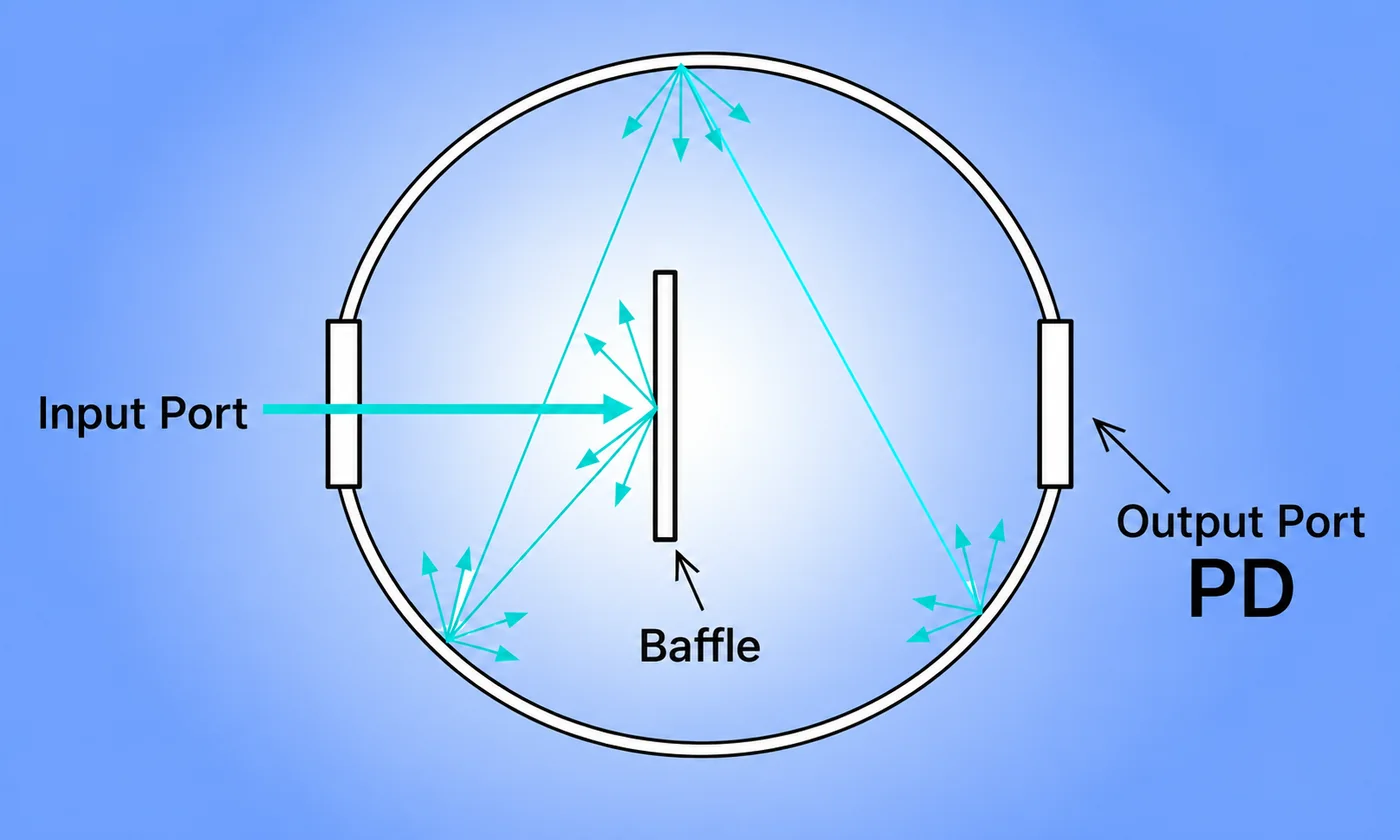
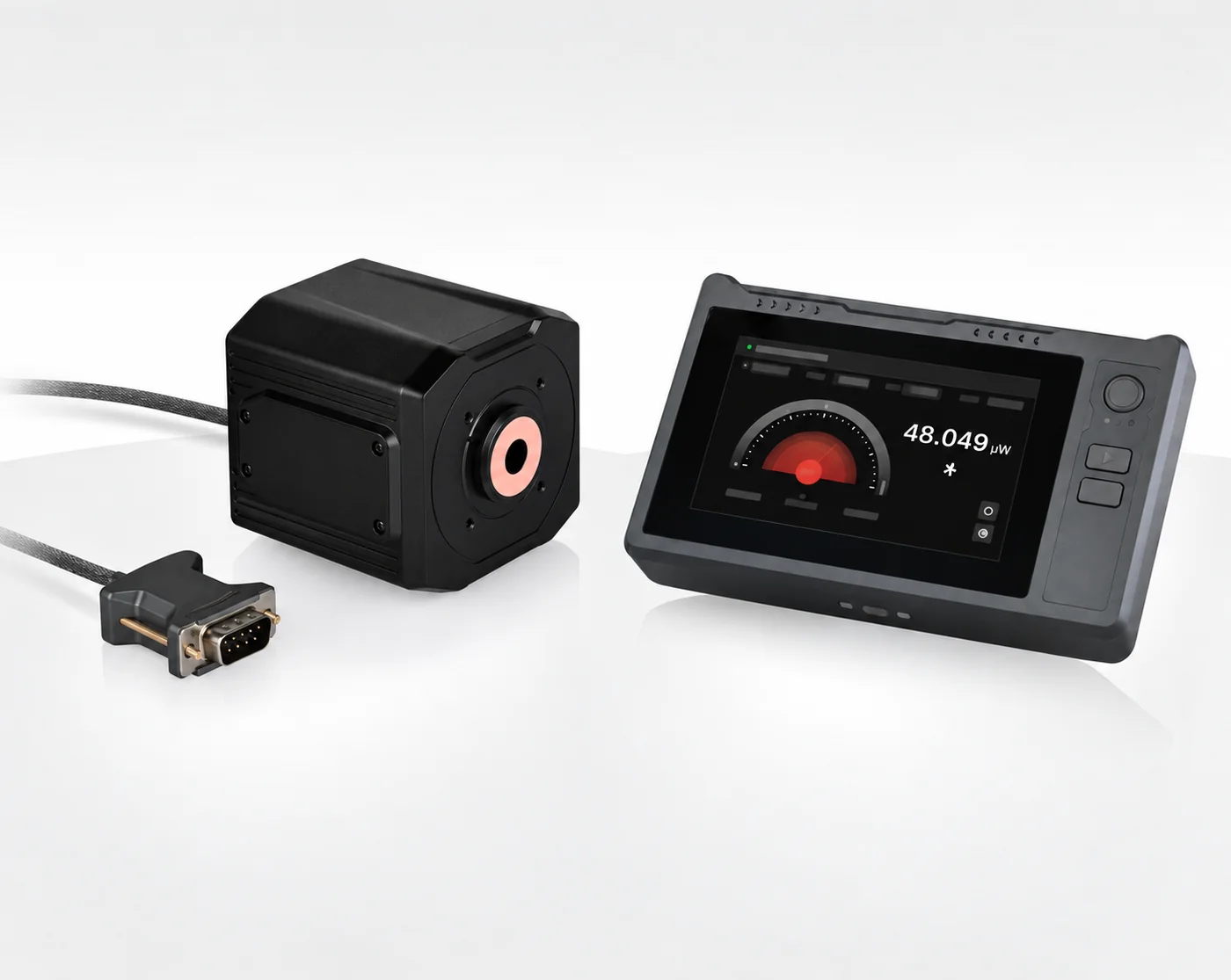
An integrating sphere uses a highly reflective diffuse coating to mix incoming light through many reflections. A shielded detector samples the nearly uniform radiance inside the sphere, reducing sensitivity to spot size, spatial profile, angle and polarization.
Strengths
- Handles divergent, nonuniform or multimode beams more consistently than a bare photodiode.
- Reduces sensitivity to beam position, shape, angle and polarization state.
- Can cover a broad spectral range when coating and detector are selected correctly.
Limitations
- Back-reflection through the input port may disturb sensitive lasers.
- The sphere is larger than a conventional detector head.
- Coatings are delicate, and power capability depends on port geometry, coating and cooling.
Best suited to: laser diodes, fiber outputs, divergent or irregular beams, radiometry and measurements where beam geometry must have minimal influence.
Thermopile Power Meters
A thermopile absorbs optical radiation and converts it into heat. The temperature difference between the hot junction and the heat sink produces a Seebeck voltage proportional to absorbed average power.
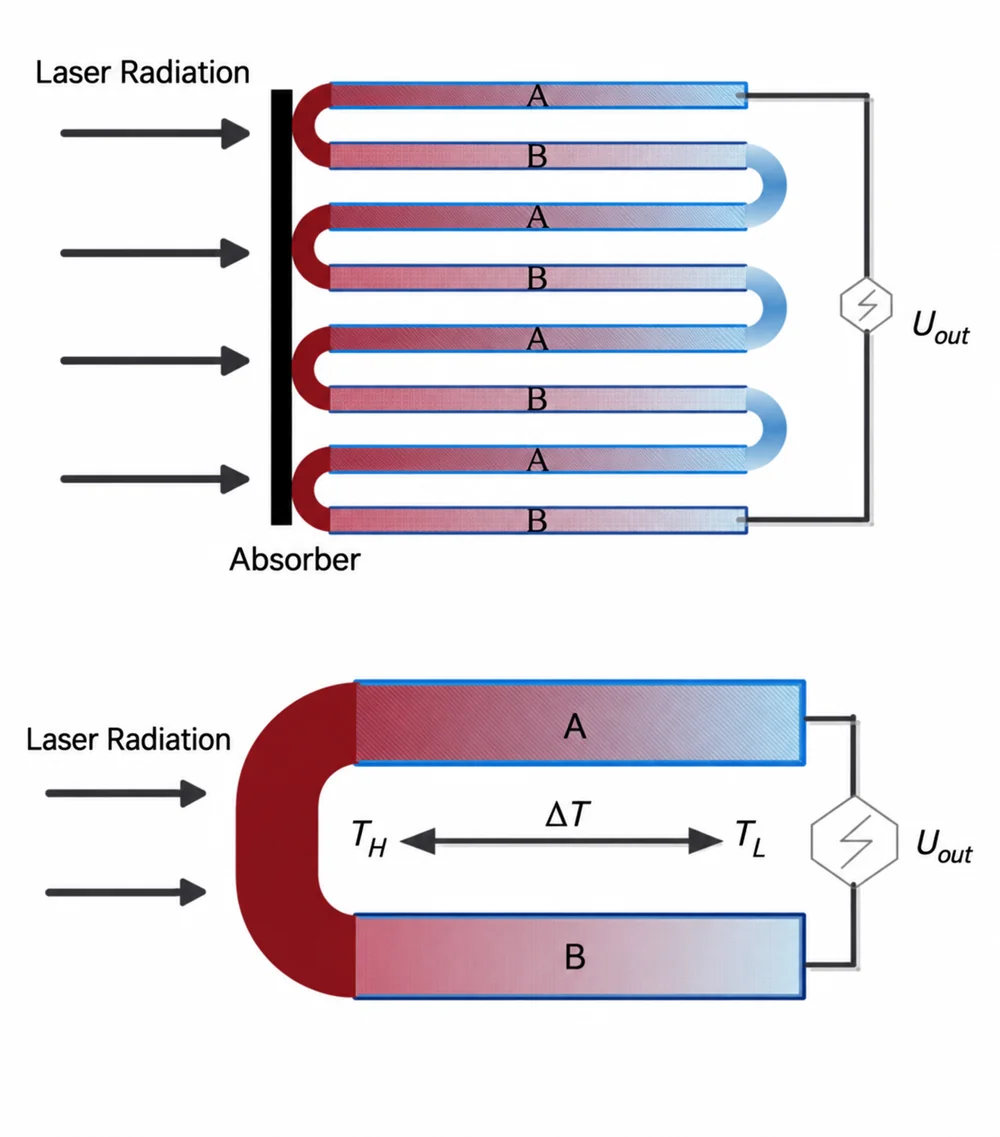
Strengths
- Broad spectral response because measurement is based on heat rather than a semiconductor bandgap.
- Wide power range, from milliwatts to kilowatts with a suitable detector and cooling system.
- Stable and robust for industrial measurements and calibration transfer.
Limitations
- Response is slow and cannot reproduce fast pulse waveforms.
- Sensitivity to very weak signals is lower than that of photodiodes.
- High-power heads may require forced-air or water cooling.
Best suited to: industrial cutting, welding, marking, cleaning, additive manufacturing, medical lasers and broad-spectrum average-power measurement.
A Practical Selection Framework
Start with the required power and wavelength range, then check beam geometry, response time, cooling, available space and calibration needs.
| Measurement need | Likely detector | Why |
|---|---|---|
| Weak optical signals | Photodiode | Highest sensitivity and fast response |
| Divergent or nonuniform beams | Integrating sphere | Minimizes sensitivity to beam geometry |
| High average power | Cooled thermopile or sphere | Choose by power density, cooling and aperture |
| Wide spectral range | Thermopile | Thermal response is comparatively wavelength independent |
| Fast transients | Photodiode | Thermopiles are too slow for waveform capture |
| Tight mechanical space | Photodiode | Detector heads can be compact |
Measurement and Safety Checklist
- Confirm wavelength, average power, peak power, beam diameter and power density before selecting a detector.
- When the power is unknown, begin with the highest safe attenuation or measurement range.
- Never exceed the detector's maximum average-power or power-density limit.
- Start air or water cooling before applying high-power laser radiation.
- Keep optical surfaces and fiber connectors clean.
- Control ambient light and thermal airflow, and perform zeroing when required.
- Wear wavelength-appropriate laser safety eyewear and never look into an optical port or fiber end.
Key Takeaway
Choose the instrument around the real measurement problem—not around the largest number on a specification sheet. Power range, wavelength, beam geometry, response speed, cooling and traceable calibration all matter.
Need Help Selecting a Laser Power Meter?
Send us your wavelength, power range, beam diameter, measurement time and cooling conditions. DDUTEC can help recommend a practical detector and display configuration.